Twelve Tools That Actually Earn Their Berth: A Boatyard Toolbag Audit
Every spring the skip outside the yard gate tells the same story: snapped hacksaw blades, a socket set missing its 10mm, three screwdrivers with chewed tips and a hammer nobody has used since 2011. Meanwhile, twenty feet away, someone's pride and joy sits on the hard with a seized seacock and nothing aboard that will shift it.
The problem is rarely that boaters don't own tools. It's that we own the wrong ones, in the wrong quantities, stored in a steel box in the dampest locker on the boat. So here's an audit: twelve items that genuinely earn their berth, what to leave ashore, and how to stop the salt air quietly eating the rest.
First, Ask Whether the Bolt Actually Exists
Before buying anything, walk round your own boat with a notebook. Measure the nuts on your engine mounts, your seacock hose tails, your battery terminals, your stanchion bases. You will find you need about six sizes, not sixty. A UK diesel auxiliary is usually metric; older boats and American imports may throw imperial into the mix; narrowboat engine bays tend to be a cheerful mixture of both.
That single afternoon of measuring is worth more than any 200-piece set from a motorist discount place. Half of those pieces will never touch a fastener on your boat, and the ones that do will round off a stubborn nut at the worst possible moment.
The Twelve
1. Combination spanners in your actual sizes
Buy individually or in a small roll. Expect 8, 10, 13, 17, 19mm to cover most of it, with 22 and 24mm for the bigger stuff. Good chrome vanadium, drop forged, with a decent ring end. Skip the pressed-steel tat that spreads under load.
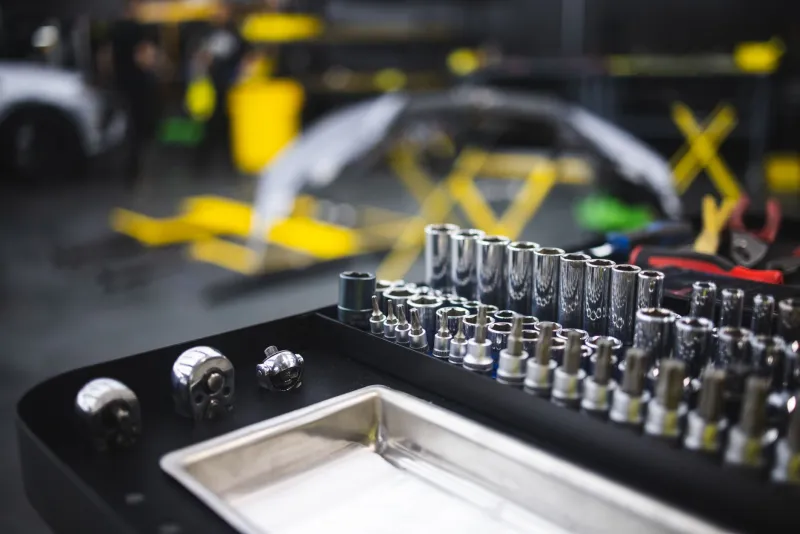
2. A six-point socket set
Quarter-inch drive for the fiddly jobs, three-eighths for everything else. Six-point sockets, not twelve — twelve-point looks clever until it rounds a corroded brass fitting. Add a long extension and a universal joint.
3. Three screwdrivers, not thirty
A Pozidriv No.2, a decent flat blade, and a stubby Pozidriv for the impossible spaces behind the electrical panel. Then a bit driver with a box of assorted bits. That combination beats a plastic case of 40 screwdrivers where 34 are the wrong type.
4. Locking pliers
For seized split pins, rounded nuts, holding a nut you cannot reach, and clamping a hose while you swap a clamp. Buy one good pair rather than three bad ones.
5. Water pump pliers
Hose clips, gland nuts, stubborn deck filler caps. Adjustable and endlessly useful.
6. A junior hacksaw with spare blades
Blades snap, and they snap on a Sunday. Keep four spares in the handle. This is the tool that gets you home when a shackle pin has welded itself shut.
7. Bolt croppers
Heavy, yes. But when a padlock has seized on a marina gate at dusk, or a rigging screw is beyond persuasion, they are worth every gram. A 600mm pair handles most boat-sized hardware.
8. Crimpers, strippers and a box of terminals
If your boat has 12V electrics — and it does — a ratchet crimper with proper insulated terminals, plus a selection of fuses, will solve more problems than any spanner. Cheap crimpers make bad joints, and bad joints make hot wires.
9. A hose-clamp nut driver and spare clamps
A flexible driver that reaches awkward clamps is a small luxury you will bless. Carry half a dozen 316 stainless clamps in mixed sizes. Skip the zinc-plated ones; they will be a brown smear by August.
10. A multimeter
Not optional. A basic one that reads volts, amps and continuity tells you in thirty seconds whether a fault is a dead battery or a broken wire. Learn to use the continuity beep before you need it in the rain.
11. A headtorch and a magnetic pick-up tool
Most boat repairs happen in a locker the size of a shoebox, at an angle, in the dark. A headtorch frees both hands. The magnet-on-a-stick retrieves the nut you just dropped into the bilge — and you will drop it.
12. A proper knife or rigging spike
A folding knife with a marlinspike handles rope work, seized knots and the endless small cutting jobs that a kitchen knife does badly and dangerously.
The Kit That Isn't a Tool
Self-amalgamating tape, PTFE tape, cable ties, a tube of grease, and a can of corrosion inhibitor. These aren't glamorous, but they are what stop small problems becoming yard bills. A wipe-down of exposed tool steel with a corrosion spray after each job adds years to the kit.
What to Leave Ashore
The 200-piece socket set. The mains power tools. A bench vice. The blowtorch. The tin of 400 assorted screws of which four are the right size. If you have not used it in two seasons, it is ballast.
Storing Tools on a Damp Boat
Skip the sealed steel box — it traps moisture and turns into a rust greenhouse. A canvas tool roll or a vented plastic tray in a dry locker is better. Keep tools out of the bilge and away from the engine bay's condensation cycle. Silica gel sachets help in a closed locker and cost pennies.
And remember that stainless is not rustproof: 316 hardware resists better than 304, but both will pit if left wet against a dissimilar metal. Dry tools, oil the pivots, and check them each spring before the season catches you out.
Budget honestly and you can cover all twelve for around £200 to £250, less if you shop boat jumbles and buy the good brands secondhand. Buy once, keep it dry, and the toolbag stops being a source of quiet shame.