Chains, Cables and Common Sense: Auditing Your Boat's Security Without Buying the Whole Chandlery Aisle
There is a particular post that turns up on marina Facebook groups every few weeks. A photograph of an empty mooring, a caption balanced somewhere between fury and disbelief, and the same question underneath. How does a dinghy just go?
It does not. Someone untied it, lifted it, wheeled it or dragged it — and they did it because it was easier than the alternatives. That is the whole of boat security in one line. You are not making theft impossible. You are making it somebody else's problem, ideally a few pontoons away, and buying enough time and noise that the maths stops working.
What actually walks in Britain
Be honest about the shopping list. Around UK marinas, canal moorings and boatyard storage, the things that disappear are rarely glamorous. Outboards come first — particularly portable four-strokes between about 2.5 and 15hp, and often with the fuel tank and tiller extension still attached. Then tenders and inflatables, trailer wheels and complete trailers, cordless tools, electronics that fit in a rucksack and outboard fuel.
Notice the shape of it: light, valuable, easy to shift, hard to trace. Nobody is stealing your anchor. They are taking whatever can be carried under one arm at eleven at night without a trolley.
Locks are delays, not force fields
What you buy with a lock is minutes, noise and awkwardness. Someone with a cordless grinder will get through most of what the chandlery sells in well under a minute — but a grinder is loud, it throws sparks, and it takes two hands on a pontoon with a camera pointing at it. That is the calculation worth bending.
So buy fewer, better locks. A Sold Secure-rated chain and padlock costs more than three cheap ones and does considerably more work. Cables are light and convenient and they are also the first thing a pair of bolt croppers beats. Cable for the tender you are leaving for twenty minutes; hardened chain and a decent closed-shackle padlock for anything sleeping out overnight.
Two rules that still get ignored. Never use a padlock whose shackle can be attacked with the boat at rest and the chain slack. And never lock a chain to itself — wrap it around something structural, like a through-bolted cleat, a mooring ring or the mast, not a stanchion base held on with four self-tappers.
Outboards reward one purchase and one habit
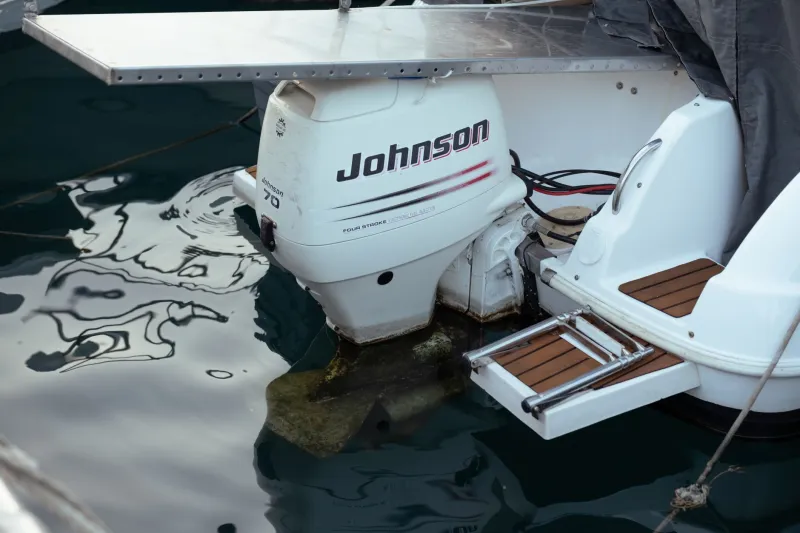
A portable outboard is the most stolen thing on this list and the most easily improved. One purchase: a proper outboard lock or locking bar that covers the clamp screws. The simple steel-plate versions work fine against opportunists; the heavier ones work against the same people with a bit more time on their hands.
One habit: if you possibly can, take the engine off and put it in the boot or the cabin. If you cannot, take the cowling off and store it elsewhere aboard or ashore. A cowling-less outboard is a nuisance to sell and a nuisance to run, and that is precisely the point. Then photograph the serial number, the model plate and the cowling decals. If it goes walkabout, that photograph is worth more than any alarm you could have fitted.
Hatches, lockers and the key question
Most boat theft is not forced. It is unhurried, because the boat was left open, or the keys were in the ignition because the boat was only going to be unattended for an hour. An hour is plenty.
Lock the cabin, yes — but also check the things that make the cabin lock decorative. Hinges with removable pins, sliding hatches with a lock on one side only, cockpit lockers that open into the cabin, washboards with a hasp screwed into 6mm ply. If the hatch lifts off its hinges, the padlock is scenery.
Keep a written key list. Not a spare key under a cockpit cushion, not one in the marina office drawer with your boat name on the fob, and not one key working the cabin, the locker, the outboard lock and your car. Keys get lost; keys get borrowed; keys get copied. Label them with something meaningless.
Mark it, register it, photograph it
Marking does two jobs: it makes your kit less attractive because it is now identifiable, and it makes recovery possible when the police do find a shed full of outboards.
Put your postcode on outboard cowlings, oars, fuel tanks and trailer cross-members — painted, engraved or in a durable marker. Add a UV pen mark in a couple of hidden spots for the items you might need to prove were yours. Kits like Datatag do the same job more formally, and free property registers such as Immobilise are worth ten minutes of your evening. If your boat is on the Small Ships Register, that SSR number is a useful permanent mark as well as a useful document.
Then build the file: receipts, serial numbers, photographs of every side of the outboard, the trailer VIN, the tender's tube seams — anything that would let you describe your own property precisely at a desk when you are upset. Insurers ask for reasonable care, and evidence of it helps.
Dinghies and trailers, the forgotten half
A tender is stolen for one of two reasons: to be sold, or to be used to get to somebody else's boat. Both are discouraged by a decent cable through the towing eye and around a fixed point, plus a mark on the transom that will not scrub off.
Trailers live outdoors, carry no registration plate of their own, and are the easiest theft in the yard. A hitch lock and a wheel clamp are the minimum. A better trick costs nothing: take a wheel home. A trailer on a stack of bricks with no wheels is not going anywhere quietly. Add the postcode to the cross-member and photograph the VIN plate before it rusts into illegibility.
The pontoon network beats the camera
Marinas with good security tend to have one thing in common, and it is not the gate. It is that people notice. Say hello to your neighbours, join the mooring group chat, and report the figure at 2am with a rucksack rather than assuming someone else has. The shared gate code is not a secret once it is in a Facebook comment thread; assume it is public knowledge and behave accordingly.
Take the ten minutes: walk your mooring, check the locks, look at the hatch, look at the tender. Most theft is a crime of easy opportunity, and easy is a thing you can edit.
Chandlery gimmicks worth walking past
Some kit earns its berth; some is theatre. Be sceptical of cheap four-wheel combination cable locks, dummy CCTV signs, nine-volt motion alarms that go off in a chop, and £300 GPS trackers on a £400 dinghy with a subscription attached. A shiny new hatch lock bolted to a hatch whose hinges lift off is money spent on the wrong end of the problem.
The good news is that the sensible list is short: a rated chain and padlock, an outboard bar or lock, a hitch lock, a wheel clamp, a marking pen, a camera, and a habit of shutting things properly. That lot will not make your boat invulnerable. It will make it the least appealing one on the pontoon, which is the only realistic aim.