Chain of Evidence: A Winter MOT for Your Anchor Rode
Anchoring has a way of exposing optimism. The forecast says force four, the anchorage looks sheltered, and the rode that has done the job for years gets lowered over the bow without a second thought. Then the wind backs, the swell finds its way in, and every link between you and the seabed starts to feel like a promise rather than a piece of kit.
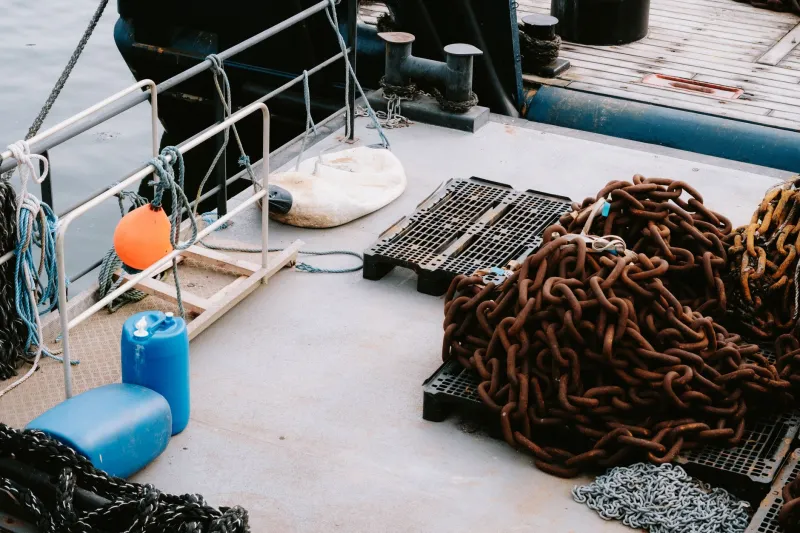
Winter is the right time to test that promise. The boat is probably ashore or doing shorter trips, the chain locker is accessible, and you can spread the rode out on a pontoon or a patch of hardstanding without an audience. It is not glamorous work, but it is the sort of maintenance that pays you back in sleep.
Start at the bitter end
Empty the anchor locker completely. Not partly — completely. The mud, grit and salt that collect at the bottom are exactly what eats chain from the inside out, and you cannot inspect what you cannot see. Put the chain and warp somewhere they can drain, then have a look at the locker itself. If the drain is blocked, fix it. If the locker is full of black sludge, shovel it out and flush it. A clean locker is not a vanity project; it is the difference between a rode that dries and one that sits wet for months.
While everything is out, check the bitter end. Is it actually secured to something structural, or is it a hopeful knot around a bit of plywood? It should be tied off so you can cut and run in an emergency, but not so lightly that it escapes when the anchor is deployed in a hurry.
Measure the chain, do not just look at it
The eye is a poor judge of chain wear. A link can look perfectly respectable while the bearing surfaces have thinned enough to matter. Get a cheap vernier caliper and measure the wire diameter at several points along the length, paying particular attention to the first ten metres and the last ten. Compare the worst reading with the original specification. As a working rule, if the chain has lost around ten per cent of its nominal diameter, it is time to think about replacement. On a ten-millimetre chain, that is a one-millimetre loss — which is not much when you are peering at it in the gloom.
Run the chain through your hands link by link. You are looking for cracked welds, deep pitting, flattened bearing surfaces and any link that has been bent or stretched out of shape. Galvanising should be dull grey, not flaking in sheets with rust blooming underneath. A little surface rust is normal and does not condemn a chain, but pitting and flaking are different animals. If a chain has been sitting in a wet locker for years, expect the worst sections to be at the bottom of the pile.
Marking links without making a mess
Chain marking is one of those jobs where everyone has a method and nobody agrees. Paint pens are fine, but they wear off quickly on a galvanised chain that works over a bow roller. Cable ties are popular, but cheap ones perish in UV and leave plastic debris in the anchorage. A better compromise is coloured chain links or sturdy markers fitted properly, with a couple of cable ties as a backup and a habit of replacing them every season.
Mark in a way that tells you something useful: ten metres, twenty metres, thirty metres. Do not mark every five metres with the same colour and then spend the night guessing. If you anchor in UK waters where tides run hard, knowing exactly how much chain is out matters more than a pretty colour scheme. A simple code — one mark for ten, two for twenty, three for thirty — is easy to remember under pressure.
Warp, shackles and swivels
If you carry a rope warp as part of the rode, unlay it and inspect for chafe, glazing and stiff patches. Chafe usually hides where the warp passes through a bow roller or a fairlead, so look at the whole length, not just the middle. A rope-to-chain splice should be checked for tightness and abrasion; if it looks tired, cut it back and re-splice it rather than hoping.
Shackles and swivels deserve the same suspicion. The shackle at the anchor should be a rated one, properly sized, and moused with wire or a sturdy cable tie so the pin cannot work loose. Stainless shackles are not automatically better than galvanised ones — they can suffer from crevice corrosion and they are expensive to replace. Check for elongation, cracks around the bow and wear on the pin. A swivel is a convenience, not a necessity, and a cheap swivel is a liability. If it is stiff, gritty or visibly worn, bin it.
The windlass and the bow roller
A tired rode often reveals itself through the hardware that handles it. Check the windlass gypsy for worn teeth and make sure it matches the chain size. A gypsy that jumps or slips under load is not just annoying; it can damage the chain and give you a false sense of security. Inspect the bow roller for flat spots, seized bearings and sharp edges. A worn roller can chafe a warp through in a single night.
Also look at your chain stopper or devil's claw. Does it actually engage properly, or is it a decorative lump of metal? If you rely on it to take the load off the windlass, it needs to fit the chain and be easy to set in the dark.
Build a snubber you can trust
The snubber is the piece of kit that turns a noisy, shock-loaded chain into something the boat can live with. A good setup is simple: a length of nylon rope, a chain hook or a rolling hitch, and a clear lead to a strong point. Nylon stretches, which is exactly what you want. Set it so the chain hangs slack below the bow roller and the snubber takes the load.
Check the hook for wear and make sure it cannot fall off if the chain goes slack. A rolling hitch is a fine alternative if you know how to tie it and can undo it after a blow. Whatever you use, practise setting it in daylight. Faffing with a snubber at midnight in a crowded anchorage is a special kind of misery.
Decide what to replace before the season starts
Not everything needs replacing at once. Chain that measures well, runs free and shows only light surface rust can usually be kept, though it may benefit from re-galvanising if you have a local firm that does it. Warp with localised chafe can be shortened. Shackles and swivels are cheap enough that there is little point nursing a doubtful one.
What you should not do is wait until the first windy night to discover that the rode is tired. Spread it out, measure it, mark it, and replace what needs replacing while the chandlery still has stock and the weather is merely grim rather than dangerous. That is the whole point of a winter MOT: it is boring on purpose, so the anchorage does not become interesting later.